
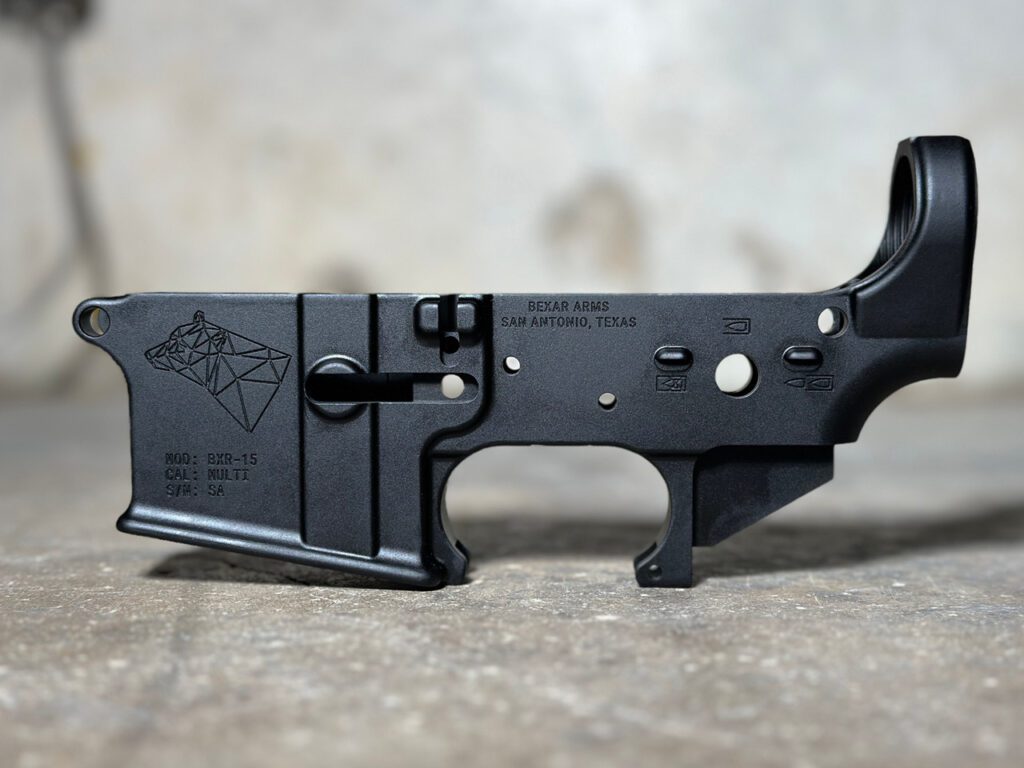
The lower receiver is the core of any AR-15. It holds the trigger group, the magazine well and the stock, and it is the part federal law treats as the firearm. That one fact drives most of the questions we get about lowers, starting with the big one: can you buy an AR-15 lower receiver with no FFL? This guide covers what a lower is, how buying one works, the main types, and what to know before you Cerakote one.
What Is an AR Lower Receiver?
An AR-15 is two main assemblies held together by two pins. The upper receiver carries the barrel, bolt carrier group and charging handle. The lower receiver carries everything you hold and operate:
- The fire control group: trigger, hammer, disconnector, springs and pins
- The safety selector
- The magazine well and magazine release
- The bolt catch
- The pistol grip
- The buffer tube, buffer and buffer spring, and the stock
- The pivot and takedown pins that join it to the upper
Because the lower doesn’t hold the barrel or the bolt, one AR-15 lower can run uppers in several calibers, from 5.56 and .300 Blackout to newer cartridges like the 6mm ARC, as long as you use the right magazine for each. Full-power cartridges such as .308 Winchester need a larger AR-10 pattern lower. For more on how the two halves differ, and on billet vs forged receivers, see upper vs lower receivers.
Is the Lower Receiver the Firearm?
Yes. For the AR-15, ATF’s regulations describe the receiver as the lower part of the weapon that houses the trigger mechanism and hammer (27 CFR 478.12). The lower carries the serial number and the maker’s markings, and it is bought and sold the same way as a complete gun. Under federal law, the upper receiver, barrel, bolt carrier group and lower parts kit are not the serialized part.
Can You Buy an AR-15 Lower Receiver Without an FFL?
Not from a dealer, and not online. A stripped or complete lower is a firearm, so it is sold the same way a complete rifle is:
- Online or out of state: the lower ships to a licensed dealer (FFL) in your home state. Federal law does not let a non-licensee bring a firearm bought in another state into their home state except through a licensee, apart from a few narrow exceptions (27 CFR 478.29).
- At the dealer: you fill out ATF Form 4473 and go through the background check, the same as for a complete rifle.
- Age: a dealer cannot sell a frame or receiver to anyone under 21. ATF treats a receiver as a firearm “other than a shotgun or rifle,” even if you plan to build a rifle on it.
- State law: some states add waiting periods, permits or limits on certain rifle features, and those apply on top of federal law.
The same rules apply to a complete lower with the parts kit, buffer tube and stock already installed. Adding parts doesn’t change what it is.
Private sales are where the “no FFL” idea comes from. Under federal law, an unlicensed person can sell a firearm to an unlicensed resident of the same state without a dealer, as long as the seller doesn’t know or have reason to believe the buyer is prohibited. Many states require private sales to go through a dealer anyway, so check your state’s law before you buy or sell a lower privately. A sale across state lines goes through an FFL.
What about 80% lowers?
Unfinished receivers, often sold as “80% lowers,” are a separate question. ATF’s rules treat a partly finished frame or receiver as a firearm if it is designed to be, or can readily be, completed (27 CFR 478.12(c)). Whether a given product crosses that line depends on how far it has been machined and what comes with it, and a number of states ban or tightly regulate unfinished and unserialized receivers. These rules have changed several times in recent years. If you are considering one, check current federal and state law before you buy.
Stripped vs Complete Lower Receivers
A stripped lower is the bare receiver with nothing installed. It is the most flexible starting point because you choose the trigger, grip, safety, buffer system and stock. To finish it you need a lower parts kit plus a buffer tube assembly and stock.
A complete lower comes assembled with the parts kit, trigger, grip, buffer system and stock. Add a complete upper and you have a working rifle. Keep the barrel length in mind: a rifle lower with a stock paired with an upper that has a barrel under 16 inches makes a short-barreled rifle under federal law. The federal NFA tax on short-barreled rifles has been $0 since 1 January 2026, federal transfer rules changed again in October 2026, and state law still applies, so talk to us before you build one. Our NFA and Class 3 dealer page has more.
Most AR-15 lowers are forged from 7075-T6 aluminum. Billet lowers are machined from a solid block and often add features like an integral trigger guard or a flared magazine well. We stock a range of AR-15 lower receivers, and M16 pocket cut lower receivers have their own category.
Blemished lowers
A blemished, or “blem,” lower has a cosmetic flaw from the factory, such as an off marking or a mark in the finish. Read each listing to see what the flaw is. A blem lower is also a good candidate for Cerakote, since the coating covers the original finish.
Cerakote on a Lower Receiver
Most lowers leave the factory hard-coat anodized black. Cerakote is a thin ceramic-based coating that goes on over that finish, so you can change the color, match a lower to an upper from a different maker, or cover a blemish. Coating the upper and lower together in the same color is the easiest way to get a rifle that matches.
The anodizing does not need to be stripped first. The receiver is taken down to the bare lower, degreased, blasted so the coating has something to grip, sprayed and oven-cured. Coating a stripped lower before you install the parts kit is the simplest route, since there is nothing to take apart.
We are a Certified Professional Cerakote Applicator. See our custom Cerakote page for finishes and how to get started. A lower is a firearm, so contact us before you ship one in and we will tell you how to send it.
Why the Lower Receiver Matters
The lower doesn’t hold the barrel, so it has less to do with mechanical accuracy than the upper does. What it does control is everything you touch: trigger feel, grip angle, safety throw, magazine changes and stock fit. A well-made lower with a good trigger is where most shooters feel the difference. Fit matters too. A lower that pairs tightly with its upper feels more solid, even if it doesn’t change where the bullets go.
Frequently Asked Questions
What does a lower receiver do?
It houses the trigger group, safety, magazine well, bolt catch, grip and buffer system, and it connects to the upper with two pins. On an AR-15 it is the serialized part that federal law treats as the firearm.
Do you need an FFL to buy a lower receiver?
From a dealer or online, yes. The lower ships to an FFL in your state and you complete the Form 4473 and background check there. Federal law allows some private sales between residents of the same state without a dealer, but many states require a dealer for those too.
How old do you have to be to buy a lower receiver?
From a licensed dealer, 21. ATF treats a stripped lower as a firearm other than a rifle or shotgun, so the 18-year-old rule for long guns does not apply to it. Some states set a higher minimum age.
Can you Cerakote an anodized lower?
Yes. Cerakote goes on over the anodized finish after the lower is degreased and blasted, then it is oven-cured. You don’t need to strip the anodizing.
How long will a lower receiver last?
With normal use and care, an aluminum lower usually outlasts the barrels, springs and small parts that wear around it. Most of the maintenance on a lower is replacing springs and pins in the fire control group and buffer system.