
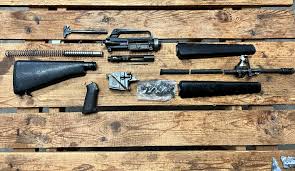
An M16 rifle breaks down into three main groups: the upper receiver group, the bolt carrier group and the lower receiver group. Below are the M16 parts names you’ll see in military manuals and parts catalogs, what each part does, and which parts differ from an AR-15. If you’re shopping for replacement parts for a registered machine gun, they’re in our M16 parts category.
The Three Main Groups of an M16
U.S. Marine Corps training material for the M16A4 and M4 names three major components: the bolt carrier group, the upper receiver and the lower receiver (USMC FMST 108, M16/M4 Service Rifle Familiarization). The same handout describes both rifles as 5.56mm, magazine-fed, gas-operated, air-cooled, shoulder-fired weapons that fire semi-automatic single shots or three-round bursts, depending on the selector. The parts names below follow that military nomenclature.
Upper Receiver Group: M16 Parts Names and Functions
| Part | What it does |
|---|---|
| Upper receiver | Holds the barrel and houses the bolt carrier group and charging handle. |
| Barrel and barrel extension | The barrel is the rifled tube the bullet travels down. The barrel extension at the chamber end has the locking lugs the bolt locks into. |
| Flash suppressor or compensator | The muzzle device. It cuts visible flash, and the A2-style compensator also helps control muzzle rise. |
| Front sight base and front sight post | The front sight base holds the adjustable front sight post. On a standard M16 it also serves as the gas block that feeds gas into the gas tube. |
| Gas tube | Carries gas from the barrel back to the bolt carrier key to cycle the action. |
| Handguards, slip ring and handguard cap | The handguards protect your hand from barrel heat. The spring-loaded slip ring and the handguard cap hold them in place. |
| Charging handle and latch | Pulls the bolt carrier to the rear to load, unload or clear the rifle. The latch locks it forward. |
| Forward assist | A plunger that pushes the bolt carrier fully forward if the bolt doesn’t close on its own. It was added on the M16A1. |
| Ejection port and ejection port cover | Spent cases leave through the ejection port. The spring-loaded cover keeps dirt out and opens when the bolt carrier moves. |
| Carrying handle and rear sight | On the M16A1 and M16A2 the rear sight is built into a fixed carrying handle. The M16A4 has a flat-top upper with a rail for optics or a removable carrying handle. |
Bolt Carrier Group: Parts and Functions
| Part | What it does |
|---|---|
| Bolt carrier | Carries the bolt and moves back and forth in the upper receiver each time the rifle cycles. |
| Bolt carrier key (gas key) | Mounted on top of the carrier. Gas from the gas tube enters here and drives the carrier to the rear. |
| Bolt | Strips a round from the magazine, pushes it into the chamber and locks into the barrel extension. Its gas rings seal against the inside of the carrier. |
| Extractor | A claw on the bolt that grips the case rim and pulls the spent case from the chamber. |
| Ejector | A spring-loaded plunger in the bolt face that pushes the case out through the ejection port. |
| Cam pin | Rides in a slot in the carrier and turns the bolt to lock and unlock it. |
| Firing pin and firing pin retaining pin | The firing pin passes through the bolt and strikes the primer when the hammer hits it. The retaining pin holds it in the carrier. |
An M16 uses the M16 (full auto) profile bolt carrier. The bolt carrier groups we stock are M16 profile, and you’ll find them in our bolt carrier groups category.
Lower Receiver Group: Parts and Functions
| Part | What it does |
|---|---|
| Lower receiver | The serialized part that holds the fire control group, magazine well, pistol grip and buffer system. Under the NFA definition, a machine gun’s receiver counts as a machine gun by itself. |
| Trigger | Holds the hammer cocked until you pull it. The M16 trigger is shaped to clear the M16 disconnector. |
| Hammer | Strikes the firing pin. The M16 hammer has an extra hook for the auto sear. |
| Disconnector | Catches the hammer after each semi-automatic shot until you let the trigger go forward. On an M16 the selector controls it. |
| Selector lever | Sets the rifle to Safe, Semi, and Auto or Burst, depending on the model. On Safe it blocks the trigger. |
| Auto sear | Found only in registered machine guns and licensed builds. It holds the hammer during automatic fire until the bolt is locked. See what an auto sear is. |
| Magazine catch and magazine release button | The catch holds the magazine in the magazine well. Pressing the button releases it. |
| Bolt catch | Holds the bolt open after the last round, and lets you lock the bolt open by hand. |
| Takedown pin and pivot pin | Join the upper and lower receivers. With the takedown pin pushed out, the upper swings open on the pivot pin. |
| Buffer, action spring and buffer retainer | The buffer and action spring sit in the receiver extension behind the lower. They slow the bolt carrier on its way back and return it forward. The buffer retainer keeps them in place when the rifle is opened. |
| Buttstock, pistol grip and trigger guard | The fixed M16 stock fits over the receiver extension. The pistol grip and trigger guard are where your firing hand sits. |
| Magazine | Holds and feeds the cartridges. Standard M16 magazines are aluminum. |
How M16 Parts Differ From AR-15 Parts
Outside the fire control group, most M16 parts follow the same pattern as AR-15 parts: barrels, handguards, charging handles, buffers, stocks, grips and magazines. The differences are the M16 hammer, trigger, disconnector and selector, the auto sear, the lower receiver made for them, and the M16-profile bolt carrier. Our full auto AR-15 guide compares those parts side by side.
ATF’s NFA Handbook warns that M16 internal components should not be used to assemble a semi-automatic AR-15 type rifle. Every full auto part we sell is a replacement part for registered machine guns and licensed post-sample builds. As our store notice says: This part will not convert your AR-15 semi-automatic to full auto function and attempting to do so without the proper license is a violation of federal law.
M16 Variants and Their Fire Control Parts
Which fire control parts a registered gun takes depends on its selector. These are the standard U.S. military configurations.
| Model | Selector positions | Fire control parts it uses |
|---|---|---|
| M16A1 | Safe, Semi, Auto | M16 full auto parts |
| M16A2 | Safe, Semi, Burst | 3-round burst parts |
| M16A3 | Safe, Semi, Auto | M16 full auto parts |
| M16A4 (U.S. issue) | Safe, Semi, Burst | 3-round burst parts |
| M4 carbine | Safe, Semi, Burst | 3-round burst parts |
| M4A1 carbine | Safe, Semi, Auto | M16 full auto parts |
Full auto guns use the M16 fire control group, which our full auto FCG parts kit covers in one order. Burst guns use their own trigger, hammer, disconnector set and cam, as in our AR-15/M4/M16 3 round burst kit.
Replacement M16 Parts From Aegis
We stock M16 fire control parts for registered machine guns: fire control kits, individual hammers, triggers, disconnectors and springs, the M16 auto sear, full auto and ambidextrous selectors, and burst parts. AR-10 owners will find our own AR-10 auto sear and FCG kit in the same full auto AR-15 and AR-10 parts category. Receivers for licensed post-sample builds are in our M16 pocket cut lower receivers category, and our custom Cerakote service covers rifles and parts.
Frequently Asked Questions
What are the main parts of an M16?
The three main groups are the upper receiver group, the bolt carrier group and the lower receiver group. The upper holds the barrel, gas system, charging handle and sights. The bolt carrier group feeds, fires and extracts each round. The lower holds the fire control group, magazine catch, bolt catch, buffer system and stock.
Are M16 and AR-15 parts the same?
Many are the same pattern, including barrels, handguards, charging handles, buffers and stocks. The fire control parts, the auto sear, the bolt carrier profile and the lower receiver are where an M16 differs.
Is it legal to own M16 parts?
Parts shared with the AR-15, such as barrels, handguards and stocks, are ordinary rifle parts. M16 fire control parts and auto sears are sold as replacement parts for registered machine guns and licensed builds, and ATF’s guidance is that M16 internal parts should not go into a semi-automatic AR-15. If you don’t own a registered machine gun, ask a firearms attorney before you buy them.